A statewide Health Data Utility gives your Rural Health Transformation initiatives a shared backbone—so every new program doesn’t require a new point solution.
Orchestral for Health Data Utility
Build the data foundation once. Answer new questions forever.
A utility, not an app.
A State Health Data Utility is a shared, statewide data foundation that securely brings together clinical and non-clinical data—so you can move faster without rebuilding infrastructure for every initiative.
Think of it like electricity: you don’t build a new power plant for every appliance. You plug into a grid.
The HDU is your data grid.
One foundation that supports:
Rural access monitoring
Medicaid transformation
Quality oversight
Public health surveillance
Research and evaluation
Workforce planning
Build it once. Use it for everything.
From point solutions to reusable capability.
| Today | With an HDU |
|---|---|
| Every initiative builds its own data pipeline. | One backbone supports many use cases. |
| Retrospective reporting (what happened last year). | Near real-time learning loops (what’s happening now). |
| Averages that hide rural reality. | Precision targeting of under-served communities. |
| Episodic measurement (one-time evaluations). | Longitudinal tracking (outcomes over time). |
| New programs require new data projects. | New programs plug into existing capability. |
What you can actually do with it.
Quality early warnings - Which MCOs or regions are at risk of missing quality targets - and why? Generate early warnings that prompt intervention before it’s too late to course-correct.
Rural hospital stability radar - Which hospitals will face declining volumes and financial stress - and what’s driving it? Predict utilization shifts that indicate future instability, enabling targeted support before crisis.
Investment ROI before you spend - What’s the likely return on a proposed program or policy change? Run scenario models to estimate impact of coverage expansions, reimbursement changes, or new services - before you commit the budget.
Chronic disease hotspot forecasting - Where will diabetes, cardiovascular disease, and other burdens concentrate next? Forecast geographic growth to guide workforce and infrastructure investments before demand overwhelms capacity.
Why this isn’t “another data platform.”
You’ve seen dashboards. You’ve funded data warehouses. You’ve sat through vendor demos promising “actionable insights.”
Here’s what’s different:
Built as a utility, not a product. Like electricity or water, a utility serves everyone who needs it - providers, payers, public health, researchers, state agencies. It’s not owned by one department or locked to one use case.
Governed for trust. Privacy-preserving by design. Clear rules for who can access what. Auditability built in. The kind of governance that lets multiple stakeholders actually use it.
Reusable by design. New initiative? New question? You don’t start from scratch. You plug into what’s already there.
Designed for rural reality. Most data platforms are built for urban health systems with big IT teams. An HDU is designed for the fragmented, under-resourced reality of rural health - where small hospitals, solo practices, and community health centers need to participate too.
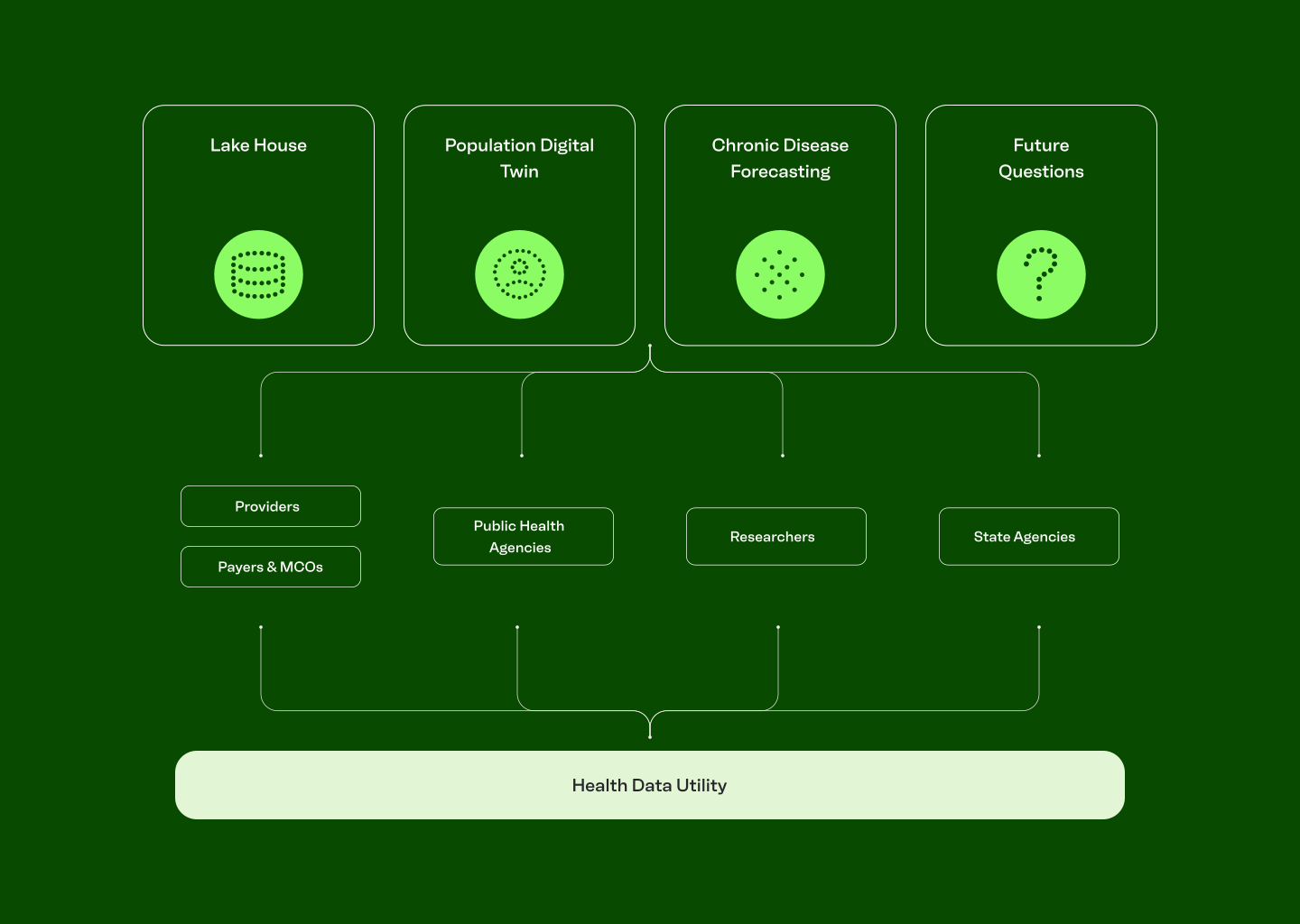
Early warnings. Smarter investments. Sustainable systems.
See what’s possible when you have a shared data foundation instead of disconnected point solutions.
Quality early warnings
The question: Which MCOs or regions are at risk of missing quality targets - and why?
The problem today: Quality data arrives quarterly or annually. By the time you see a problem, it’s too late to fix it for this measurement year. Interventions are reactive, not proactive.
What the HDU enables: Near real-time monitoring of quality indicators across MCOs, regions, and populations. Early warning signals when metrics start trending in the wrong direction—with enough lead time to intervene.
Who uses it: State Medicaid agencies, MCO oversight teams, quality improvement staff.
Rural hospital stability radar
The question: Which hospitals will face declining volumes and financial stress - and what’s driving it?
The problem today: Rural hospital closures often come as a “surprise” - but the warning signs were visible in utilization data months or years earlier. Without a way to monitor facility-level trends, states react to crises instead of preventing them.
What the HDU enables: Predictive monitoring of utilization patterns, payer mix shifts, and service-line trends that indicate future financial stress. Early signals that enable targeted support - workforce investment, service-line planning, or financial intervention—before closure becomes inevitable.
Who uses it: State offices of rural health, hospital association partners, Medicaid agencies, workforce planners.
Investment ROI before you spend
The question: What’s the likely return on a proposed coverage expansion, reimbursement change, or new program?
The problem today: Major investments get approved based on projections built from incomplete data and optimistic assumptions. Evaluation happens years later - after the money’s spent and the political moment has passed.
What the HDU enables: Scenario modeling that estimates impact before you commit. Test coverage changes, reimbursement adjustments, or program designs against actual population data. Understand who benefits, what it costs, and where the risks are - before the budget is locked.
Who uses it: Medicaid policy teams, state budget offices, program designers, legislative staff.
Chronic disease hotspot forecasting
The question: Where will diabetes, cardiovascular disease, and other chronic conditions concentrate in the next 5-10 years?
The problem today: Workforce and infrastructure investments are based on where disease burden is today - not where it’s heading. By the time a community is overwhelmed, it’s too late to train providers or build capacity.
What the HDU enables: Geographic forecasting of chronic disease growth based on demographic trends, social determinants, and current prevalence patterns. Guides workforce pipeline investments, facility planning, and preventive care targeting - before demand exceeds capacity.
Who uses it: Workforce development boards, state offices of rural health, public health planners, health professional schools.
What question would you answer first?
Every government’s priorities are different. Let’s talk about which use cases matter most for your health transformation goals.