Orchestral Intelligent Health Data Platform

AIInteroperabilityData PlatformHealth Data Model

Unified health data platform

Orchestral is the world’s first all-in-one intelligent health data platform designed to unify and contextualize healthcare data for healthcare providers, government and life sciences. Purpose-built for the complexities of healthcare, Orchestral allows you to ingest, store, analyze, and operationalize health data from any source and output it in any format.

Eliminate the cost, complexity and time of wiring together generic products from vendors. Orchestral delivers a complete platform and provides the support to resolve issues wherever they occur in the healthcare journey.

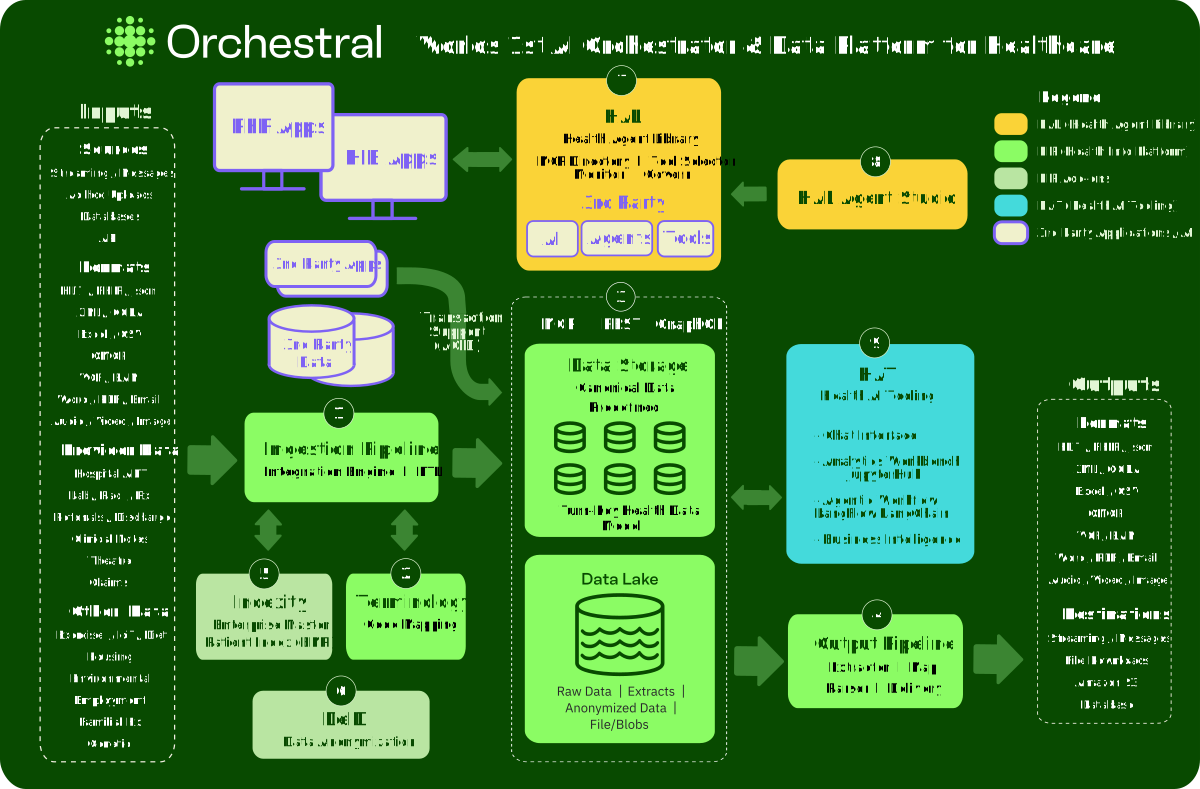
The building blocks of the Orchestral platform are depicted in the diagram and detailed in the following table along with common “best-of-breed” applications in each market category.

All-in-one data platform building blocks

Rather than assembling piecemeal technologies with ever increasing costs, Orchestral provides all the critical technologies required to run from day one. Eliminate costly consulting, IT and integration requirements. Reduce data and security risks, accelerate time to insights and outcomes.

DataPlatform.svg

Features

  • Pre-built Health Data Model (HDM) ready for immediate use acts as an independent layer between data inputs and outputs, allowing any healthcare data format to be ingested and transformed immediately.

  • Configurable ingestion and output pipelines for any data format including HL7, FHIR, CCD, and CSV. Authorized applications connect through secure API endpoints to read and write data. No format conversions or middleware required.

  • Secure API endpoints to connect Orchestral with your existing systems, applications, and digital health tools, with full ACID support for data going into or out of the HDM.

  • Built-in Jupyter Notebooks provide immediate access to data for custom analytics, reporting, and research. Users can train models and generate insights without moving data to external systems.

How Orchestral works

① Ingest data

Orchestral ingests data from any source via fully configurable pipelines. These pipelines validate, standardize, reorder and contextualize all incoming data.

For example, where incoming data is about one person, or related to one physical address, Orchestral will use matching logic to make links to existing records about that person or address, no matter if it comes from a different source. As more data is added, the relationship web grows.

Learn about Ingestion Pipelines

② Resolve identities

The base Orchestral platform uses smart business logic to match incoming data against existing data. This function can be further enhanced by adding in the Indexity product to supercharge the identity management logic.

Learn about Indexity

③ Resolve codes

During ingestion, the inbuilt terminology service will reference the configuration for each coded value or coded element it encounters to determine the correct valueset or vocabulary table to use to resolve the code. This service comes pre-configured with medical vocabularies and terminologies.

Learn about Terminology

④ Anonymize data

Data can be anonymized with the DeID add-on before being saved as a dataset, an important step in using health data for analysis.

Learn about DeID

⑤ Store data

All incoming raw data is stored and catalogued, in its original form, in the Data Lake. This way no data is ever lost, even if an issue occurs during the ingestion process and the data cannot be saved into the canonical database, the HDM. Any data can be re-ingested (replayed) later from its raw copy in the Data Lake.

The canonical database is the HDM, made up of domains specific to healthcare. This is a Postgres database that stores all of the processed data items, along with their relationship links and provenance (point of origin) information.

Learn about Data Storage

⑥ Output data

Once in the HDM, your data can be queried, structured into any format, and delivered to your chosen destination via the fully configurable output pipelines.

Learn about Output Pipelines

⑦ Analyze and report

Access secure Jupyter Notebooks, custom dashboards, and reporting tools. Generate insights, track KPIs and support research - all within a protected governance boundary. Orchestral comes with a Jupyter environment and a library of pre-built Notebooks, ready to run.

Curated datasets generated through queries can be saved to the Data Lake, where it can be accessed quickly by dashboards or reporting tools. These processed datasets can be updated manually, or through a scheduled task.

Learn about Analysis and Reporting

⑧ Business intelligence

Business intelligence refers to the layer of tools and capabilities that turn unified, governed health data into actionable insight for decision-makers. It includes real-time dashboards for data quality and system activity, analytics built from processed datasets in the Data Lake, custom reporting created through Jupyter-based jobs, and the ability to surface trends, performance metrics, and population insights across clinical, operational, and financial domains. This allows leaders to monitor what is happening in their system, understand why it is happening, and drive improvements through evidence-based decisions supported by trustworthy, AI-ready data.

AI platform

Orchestral comes with AI built into the core of the platform. Teams can interact through an intuitive chat interface that makes it easy to query data, surface insights, and automate tasks using healthcare-specific prompts. A rich prompting library accelerates adoption, giving clinicians and administrators ready-made ways to ask questions, run analyses, and activate workflows without needing technical expertise.

Beyond these inbuilt capabilities, Orchestral IQ unlocks advanced AI through agentic workflows and a central algorithm hub. Healthcare providers can deploy pre-built or custom AI agents that coordinate tasks, trigger interventions, and feed results directly into clinical workflows. Every model, agent, and algorithm is stored, versioned, and governed in one secure repository, with PHI-protected large language models, retrieval-augmented generation, and integration into the HDM. This turns healthcare AI from experimental pilots into operational intelligence at scale.

Learn about IQ

Manage the process

Orchestral itself is a headless application, but it includes the following tools to provide oversight, configuration and customization of different aspects of the platform:

  • Data Catalogue - auto-generated schema explorer for instant data discovery. Shows you what your HDM looks like, where every single piece of data is stored, and what links it has to related data.

  • Domain Modeller - visual interface to extend the HDM without writing code. Drag boxes, add fields, create links between related data, then deploy it to your environment.

  • Domain Mapper - configure how source data is mapped into the HDM. Take full control of where each individual data item goes, how it is saved, and what transformation (if any) is applied.

  • Environment Manager - manage data providers, data items, and pipeline configurations. Use the pre-built pipelines we’ve created, clone and edit, or create your own from scratch.

  • Processor Designer - upload, version and deploy AI and ML models to live environments.

  • JupyterHub - query your data through Jupyter Notebooks, all within the data governance boundary. Create your own or use our pre-built library of Notebooks.

Benefits

Trusted governance and security

Orchestral embeds enterprise-grade data governance throughout:

  • Patient consent & access policies.

  • Role-based access control.

  • Separation of design-time vs runtime.

  • Deidentification and anonymization for research.

  • Audit logs and breach response plans.

Integrate and automate

Use secure, scalable APIs to connect Orchestral with your existing systems, applications, and digital health tools. Trigger alerts, orchestrate workflows, and deliver real-time insights across your ecosystem.

Orchestral includes a suite of robust APIs that enable:

  • Write (async) - submit data to the HDM.

  • Search (sync) - paginated querying of standardized health data.

  • Get (sync) - retrieve specific records or bundles.

  • Bulk - export large datasets for downstream consumption.

  • Event Subscription (pub/sub) - notify external systems when critical events occur.

These APIs give you secure, ACID compliant access to the HDM, Data Lake and AI models, allowing seamless integration with client apps, services, and analytics platforms.

Client apps interact with Orchestral through:

  • Client App Services - use APIs to connect directly to the HDM and AI platform.

  • Integration Services - bridge Orchestral with external 3rd party systems.

  • Agent Integration (via MCP) - intelligent agents can query, write, and process data using the same secure APIs.

Whether on mobile, desktop, browser, or device, these APIs allow your custom apps to deliver powerful health data experiences, with Orchestral handling the complexity behind the scenes.

Extend and customize the core product

Orchestral’s extension model allows client-side developers and digital health vendors to build fully customized apps and services on top of a stable core. This separation between core and custom ensures upgrades are safe; core updates never overwrite your work.

What makes Orchestral different?

  • Health-First Architecture - designed exclusively for healthcare with an extensible HDM optimized for real-world clinical and administrative data.

  • Any Data In, Any Data Out - supports over 100+ data formats including HL7, FHIR, CSV, and CCDA, enabling seamless interoperability.

  • No-Code/Low-Code Tooling - designed so healthcare domain experts, not just engineers, can configure, extend and manage the platform.

  • API-Driven by Design - secure, standards-based APIs allow client applications, systems, and services to write to and read from the platform, or trigger actions in real time.

  • AI-First and Future-Proof - built-in tools for training and deploying AI and ML models, supporting both traditional analytics and cutting-edge large language models.

  • Safe by Design - security, consent and privacy are core - from fine-grained access control to full audit trails and compliance.

Get Started with Orchestral

Use cases

Population health management

  • Population-wide data aggregation from any healthcare source.

  • Advanced risk stratification and predictive analytics.

  • Automated care gap identification and closure workflows.

  • Social determinants integration for health equity initiatives.

  • Real-time population health monitoring and alerts.

Read about Population Health

Healthcare data quality assurance

  • Built-in validation at every step checking structure, required identifiers, and duplication.

  • Comprehensive dashboards to examine the data quality from multiple aspects - raw vs specification, raw data analysis, validation results.

  • Healthcare-specific handlers that act as gatekeepers of the data, ensuring it is trustworthy and meaningful.

  • AI-driven analysis and insights to detect and resolve data quality issues.

  • A constantly evolving platform built by healthcare data professionals to identify idiosyncrasies, document edge cases, and collaborate to improve the quality of incoming data.

Read about Healthcare Data Quality Assurance

Value based care

  • Automated quality measure calculation and reporting.

  • Real-time contract performance monitoring and analytics.

  • Risk adjustment optimization and documentation improvement.

  • Care gap identification and closure workflow automation.

  • Population health management for defined patient panels.

Healthcare analytics

  • Dashboards to gain immediate oversight of your data traffic, quality and processing.

  • Just-in-time warehousing of processed datasets to power analytics workflows, performance benchmarking, and real-time reporting.

  • Built-in intelligence trained on decades of healthcare data knowledge and expertise and integrated with AI models.

  • Secure analytics environment where it all happens within your data governance boundaries - no compromising privacy.

Read about Healthcare Analytics

Get Started with Orchestral


Frequently asked questions

What is Orchestral?

Orchestral is a purpose-built healthcare data platform that processes any health data format and delivers insights from day one. Unlike generic platforms requiring months of customization, Orchestral includes a pre-built Health Data Model and healthcare-specific pipelines.

How long does it take to implement Orchestral?

Most healthcare organizations are operational within 2-4 weeks. Orchestral is commercial off-the-shelf software that emphasizes configuration over customization, eliminating the 12-18 month builds required by generic platforms.

Get an implementation timeline .

What makes Orchestral different from generic data platforms?

Orchestral understands how healthcare data is collected, linked, and coded. Generic platforms require extensive modification and create dependencies. Our 20+ years of healthcare expertise are built into the platform, reducing consultant costs and deployment risk.

What data formats does Orchestral support?

Orchestral handles any healthcare data format including HL7, FHIR, CCD, and CSV through configurable pipelines. The HDM acts as an independent layer between inputs and outputs, so new formats integrate without disrupting workflows.

How much does Orchestral cost?

Pricing depends on data volume, users, and features. Most customers find 40-60% lower total cost versus building on generic platforms due to reduced customization needs. Reference engagements range from $500K-$3M annually including implementation.

Get a quote .

What AI capabilities are included?

Orchestral includes infrastructure for training and deploying traditional ML models and large language models. Data pipelines are optimized for AI interpretation within secure healthcare governance boundaries. Deploy AI in weeks, not months.

Learn about AI features .

How does Orchestral ensure data security and compliance?

Orchestral encrypts data at rest and in transit, implements role-based access controls, and separates design-time from runtime environments. The platform aligns with ISO 27001 and SOC 2 standards and includes comprehensive patient consent management.

Review security and compliance features .

Can Orchestral scale for large healthcare systems?

Yes. Orchestral runs on proven big data technologies including Kafka, Spark, and Kubernetes. The platform automatically scales on AWS infrastructure from single hospitals to national networks, handling petabyte-scale data without performance degradation.

How does Orchestral integrate with existing systems?

Orchestral provides secure API endpoints and supports standard healthcare formats for seamless integration. The platform ingests data from current systems and provides processed data back through standard interfaces without format conversion complexity.

What results can we expect from Orchestral?

Customers typically see operational results within 30 days including faster analytics, reduced manual data handling, and accelerated reporting. Healthcare organizations spend 60% less time on data wrangling and more time on insights.

What support do you provide during implementation?

Orchestral provides dedicated healthcare data specialists throughout deployment including solution architects, data engineers, and project coordinators. Our team knows healthcare data better than anyone - you focus on insights, not technical setup.

Who is Orchestral designed for?

Orchestral serves healthcare providers, health systems, government agencies, and research institutions that need to process, analyze, and act on health data at scale. Ideal for organizations tired of generic platforms that don't understand healthcare workflows.