Data Quality in Orchestral

Data PlatformData QualityAIHealth Data Model

High-quality data is the foundation for safer, smarter, and more equitable healthcare. We’ve built Orchestral with data quality at its core, giving providers the confidence to act on insights with speed, precision and trust.

Data quality is a prism, not a checkbox

Data quality can’t be measured from a single angle. Just because data matches a specification doesn’t mean it’s accurate, meaningful or trustworthy. At Orchestral, we treat data quality as a multi-faceted prism, examining structure, format, content, business logic and provenance across all stages of ingestion.

Orchestral supports a comprehensive quality lens, including:

  • Raw vs specification - compares raw data against defined specs - highlighting extra or missing elements.

  • Raw data analysis - goes deeper to understand the nature and quirks of the data itself - exposing inconsistencies like non-standard vocabularies or unexpected value patterns.

  • Domain-level validation - each aspect of the data (e.g. Patient, Diagnosis, Encounter) has its own criteria, handled by intelligent gatekeepers that know what valid data should look like.

Built-in validation at every step

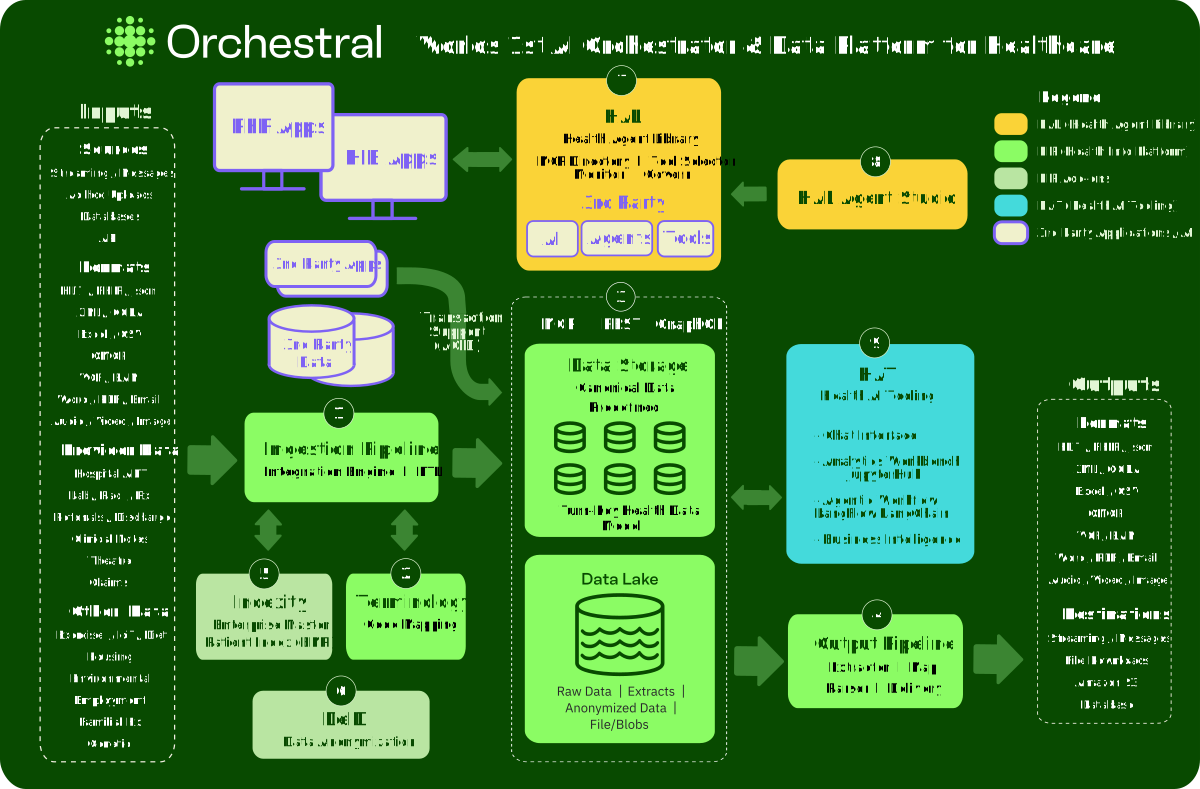
As data arrives, Orchestral runs it through a powerful Validation Service that checks for:

  • Structural integrity (headers, columns, fields).

  • Presence and placement of required identifiers.

  • Duplicate detection via hash comparison.

Records that fail these checks are routed to a dedicated queue and surfaced in the Data Quality Dashboard, where trends and anomalies are highlighted through real-time alerts.

Gatekeepers of the Health Data Model

Beyond structural validation, Orchestral employs domain-specific handlers that act as gatekeepers of data quality:

  • Do we have the minimum values required to create a valid record?

  • Is there already a matching record in the Health Data Model?

  • If so, should we update, merge, or raise an exception?

Each domain service applies its own contextual rules, ensuring data is trustworthy and meaningful. Where data is usable but imperfect, non-fatal warnings are generated, along with metadata tags explaining the anomaly and flagging it for review by data stewards.

AI-driven analysis and insights

Orchestral’s AI capabilities enhance the ability to detect and resolve data quality issues. Current and future features include:

  • Post-ingest AI validation for detecting inconsistencies between patient demographics and diagnoses or medications.

  • Trend monitoring to see whether a provider’s data is improving or deteriorating over time.

  • Data quality assessments at onboarding, with repeat assessments to track changes and identify gaps.

  • Custom business validation rules, letting organizations configure their own attribute checks and success criteria.

Tools for understanding and action

Orchestral gives analysts and stewards the tooling they need to maintain and improve quality at every stage:

  • Data Catalog - searchable dictionary of fields and attributes, auto-generated and always up to date.

  • Domain Mapper & Modeller - map and extend your data model visually, with clarity and control.

  • Environment Manager - customize pipelines and vocabularies for each data provider.

  • Jupyter Notebooks - analyze, report and benchmark data quality securely within the data governance boundary.

Future capabilities will allow data stewards to drill into error types, replay problematic records, and manage fixes directly within the platform, transforming warnings into actionable improvement plans.

More than a platform, a partnership

Our data analysts don’t just build pipelines, they invest the time to understand your data, your providers, and the way your organization represents care. We identify idiosyncrasies, document edge cases, and collaborate to improve the quality of incoming data. It’s this hands-on approach that sets Orchestral apart.

Why it matters

In a healthcare setting, poor data quality isn’t just a technical issue, it’s a patient safety issue. Orchestral ensures:

  • Data is validated, standardized and contextualized from the outset.

  • Patient consent, sensitivity and access controls are respected and enforced.

  • Insights are generated from a trusted, transparent and traceable foundation.

A platform that learns and improves

Orchestral includes built-in observability and alerting, supports real-time feedback loops, and allows you to replay data as validation rules evolve. This is a platform designed not only to meet today’s standards, but to drive tomorrow’s improvements.